
Adlib
Hackathon
A concept app surfacing last-minute, discounted spots in local workshops, fitness classes, and events, turning unsold capacity into a low-stakes way to try something new tonight. Placed 2nd at Converge 2026, a 5-hour designathon organized by FLUX.

The Brief
Converge 2026 is a 5-hour designathon organized by FLUX, and this year’s theme was Parallel Lives: how people can experiment with different identities, paths, and interests without much risk or commitment. The prompt pushed us to ask why so many alternate versions of a person’s life stay hypothetical: the hobby they never tried, the class they kept meaning to take, the version of themselves they’re curious about but never became. Time, money, and the fear of disrupting an existing routine get in the way every time.
I worked with three teammates: Felicia Wang, George Gu, and Eva Chong, under FLUX’s constraints: design from scratch, any assets, AI use allowed if disclosed, five hours from concept to a presentable pitch.
The Challenge
Our read on the brief was that a fantasy simulator would miss the point. Nobody needed a mood board for the life they’re not living, or another app to help them plan out their life—for us, we wanted to make it as easy as possible to actually do something new. So we set out to design something that made a real new experience feel low-stakes enough to say yes to on short notice.
The Process
The day broke into four blocks: an hour of research and ideation, ninety minutes of wireframing and structure, ninety minutes of high-fidelity design, and thirty minutes packaging everything into a pitch, with a lunch break wedged into the middle. Sixty minutes in, we landed on the mechanic that became Adlib: unsold inventory meets curious people.
Working with Felicia on UX and product design, we owned the middle two blocks, turning that raw mechanic into an actual flow. How does someone discover a nearby opening, decide it’s worth their evening, and book it, and what does that experience need to look and feel like so trying something new tonight reads as easy instead of intimidating? That flow became the backbone the rest of the deck, the business model and the pitch narrative, got built around.
Learning What Someone Actually Wants to Try
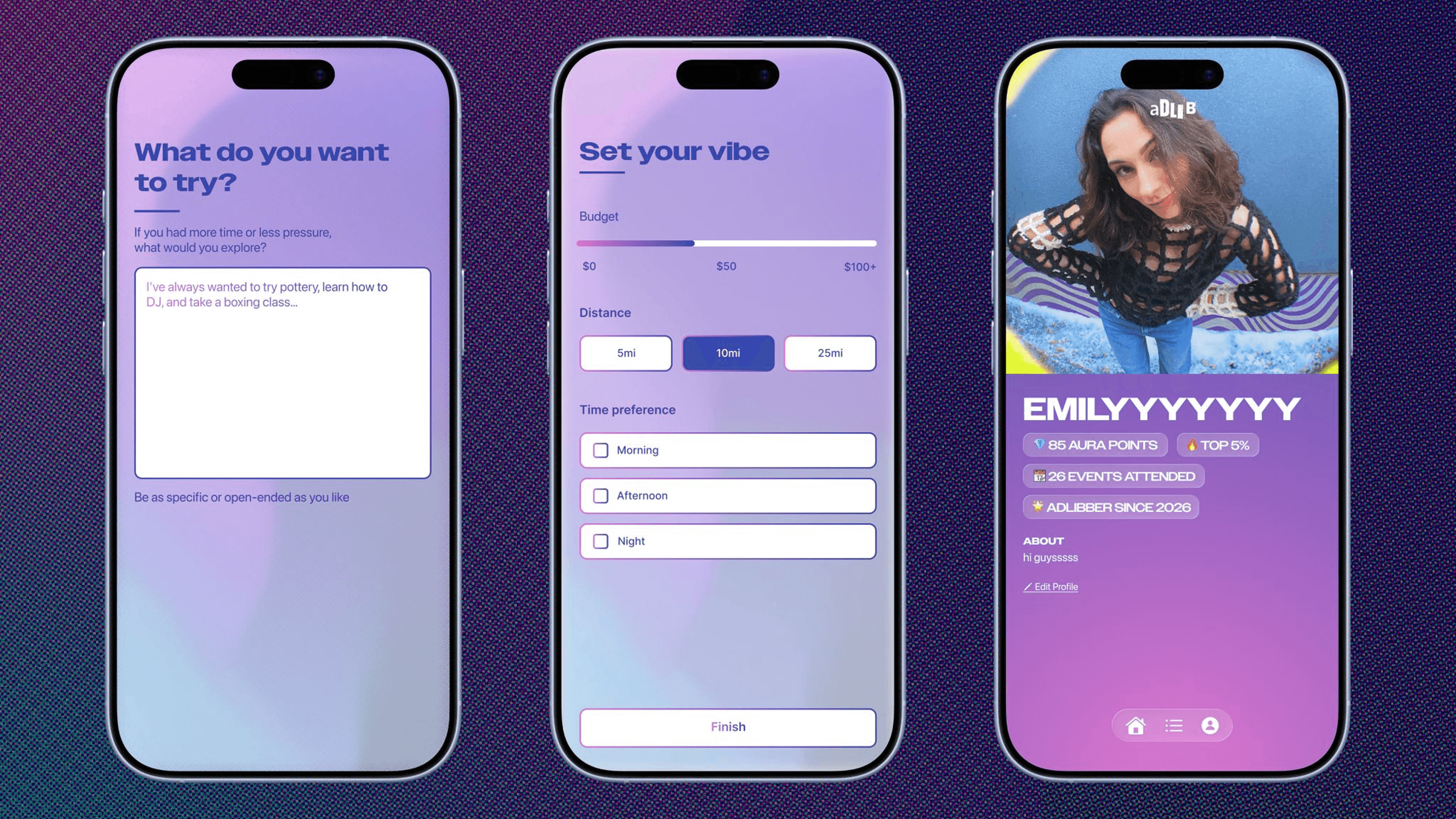
The first screens I designed handle onboarding. Instead of a static list of categories, we opened with a blunt prompt, what do you want to try, and let people answer in their own words: pottery, DJing, boxing, whatever they’ve been putting off. From there, a short set-your-vibe step collects budget, distance, and time preference, so the feed that follows is already narrowed to what someone would actually say yes to. A lightweight profile with an aura-points system sits behind it, turning attendance into a small, visible track record rather than a one-off transaction.
The Solution
Adlib works like a marketplace for spontaneity. Businesses list last-minute openings: two empty wheels at a pottery studio tonight, unfilled spots in a boxing class, unsold tickets an hour before a show, at a discount. Users see what’s available nearby, right now, and can book in a couple of taps.
Turning a Notification into a Yes
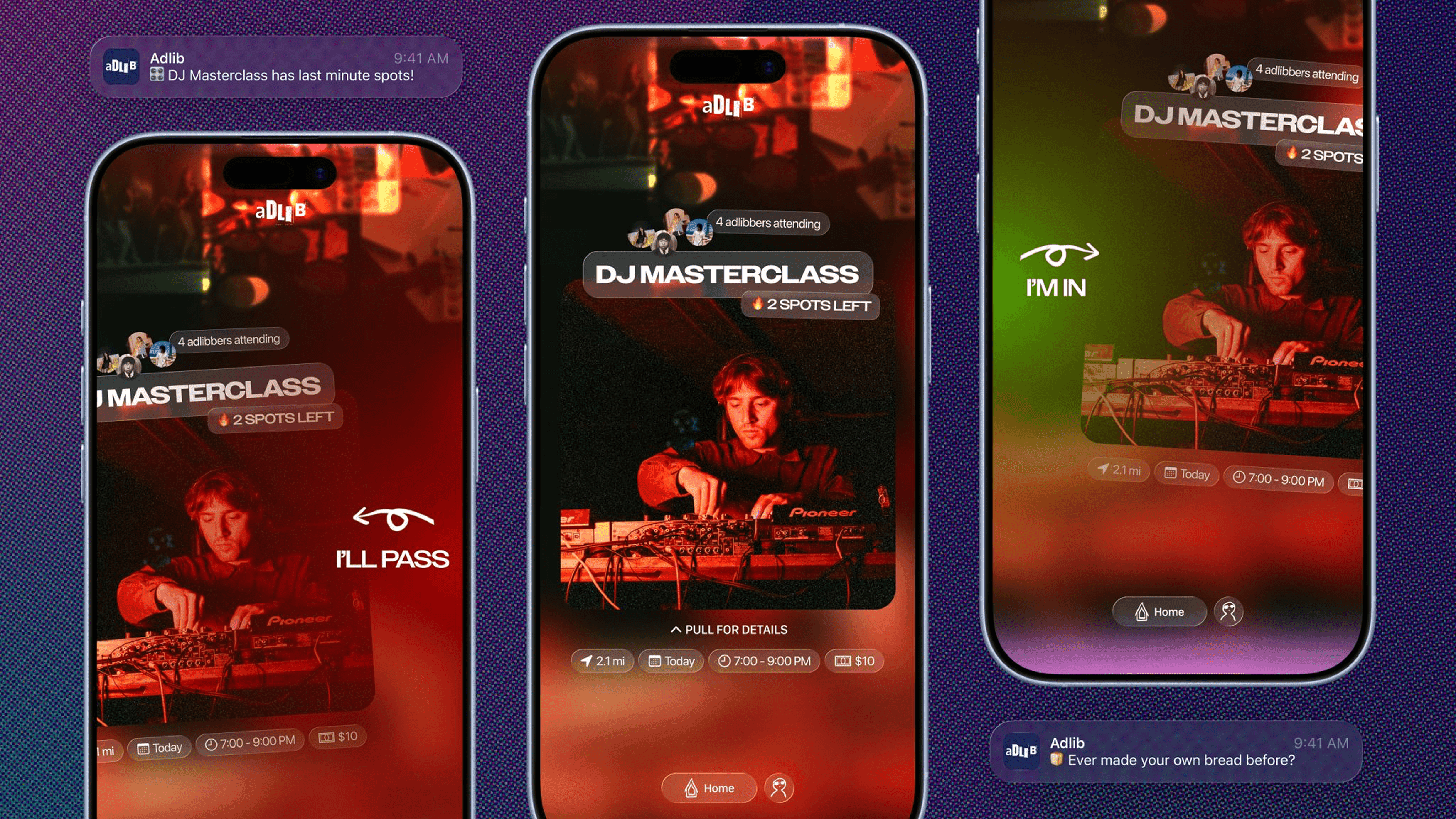
We designed the discovery layer around a push notification and a single swipeable card, closer to a dating app than an events listing. A notification about last-minute spots opening up drops straight into the card: the venue, who else is already going, how many spots are left, with only two decisions to make, pass or join. Cutting the interaction down to one card and one choice was the whole point. Every extra tap was a chance for someone to talk themselves out of it.
Booking, Social Proof, and Coming Back
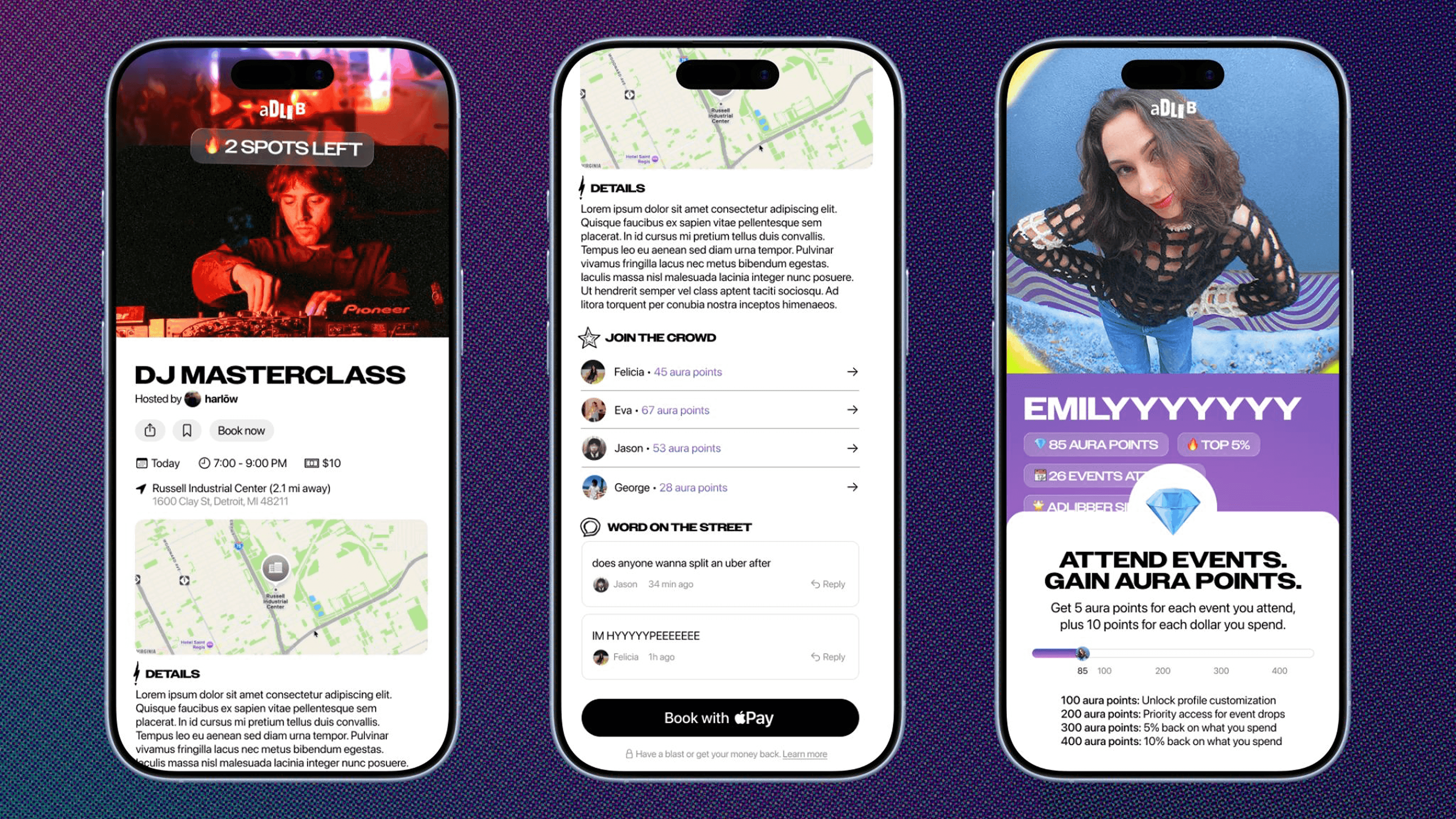
Saying yes drops into an event detail page with a map, a host, and a join-the-crowd list showing who from your circle is already attending, the social proof that makes showing up to a stranger’s DJ workshop feel less like a risk. Booking happens with Apple Pay in the same screen. Underneath it all, an aura-points system rewards attendance and spend, unlocking profile customization, priority access to future drops, and cash back at higher tiers, a small loop meant to turn a one-time impulse booking into a habit.
The design goal underneath all of it was removing the three things that normally stop someone from trying something new: cost, handled by the discount, planning, handled by same-day booking instead of committing weeks out, and decision fatigue, handled by a curated, time-boxed feed instead of an open-ended search. It’s a small mechanic, but it maps directly onto the parallel-lives prompt. It turns the pottery class you keep meaning to try from a someday-thing into a tonight-thing.
Outcome
Adlib placed 2nd out of the teams competing at Converge 2026. The judges’ feedback kept coming back to one thing: the UX, the business model, and the pitch story all pointed at the same idea, giving the concept a clear answer for why both sides of the marketplace, businesses with unsold capacity and people looking for a low-stakes way in, would actually use it.
Team
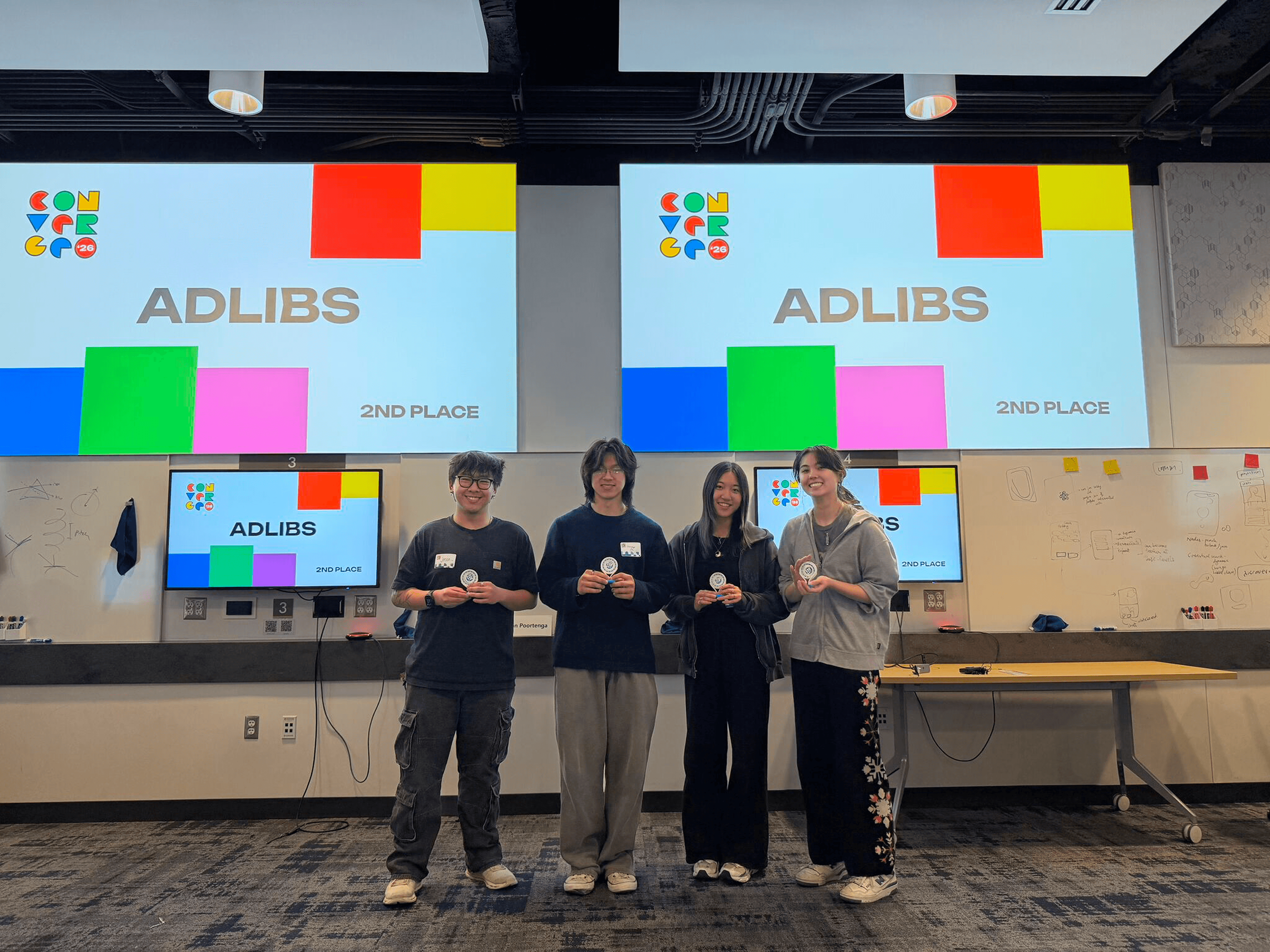
Felicia Wang, George Gu, and Eva Chong were absolutley wonderful to work with. A five-hour deck doesn’t come together without everyone pulling in the same direction. Thanks also to FLUX for organizing Converge and to the judges for a thoughtful, fast-moving event.